A Bigger Question for the Future of Medicine
People are starting to talk about the possibility of treatments that could change how we approach many diseases at once. AI-designed drugs, longevity medicine, cellular reprogramming, inflammation biology, metabolic therapeutics, and molecular platforms are all pushing medicine toward bigger questions.
It sounds crazy at first.
But maybe not as crazy as it sounded ten years ago.
So here is my question.
If the world is starting to think about treatments that could impact many diseases at once, why are we still measuring the human body using the same fragmented signals we have used for decades?
Heart rate. Blood pressure. Oxygen saturation. Respiratory rate. Temperature.
All of them are important. All of them are useful. All of them can be life-saving in the right context. But they are still only pieces of the body. They are not the body itself.
Introducing UVS
I think medicine needs a new kind of vital sign.
A Universal Vital Sign.
In short, UVS.
The physiological mother of all vital signs.
I do not mean another random number on a monitor, or another dashboard filled with isolated readings. I mean one personalized, continuous, digital physiological marker that can tell us whether the human body is stable, drifting, compensating, recovering, or silently deteriorating.
To be very clear, UVS is not a diagnosis. It should not replace doctors, clinical judgement, blood tests, imaging, or disease-specific investigations. Its purpose is not to say, “You have dengue,” or “You have cancer,” or “You have sepsis.”
Its purpose is to ask a more fundamental question:
Has this body moved away from its healthy physiological baseline?
That question may become one of the most important questions in the future of medicine.
Disease Begins as a Shift
Most diseases do not begin as a label. They begin as a shift. A shift in autonomic tone. A shift in vascular behavior. A shift in respiratory compensation. A shift in inflammation. A shift in metabolism. A shift in sleep and recovery. A shift in neurophysiology. A shift in how the whole system holds itself together.
By the time our traditional vital signs become abnormal, the body may already be far down the path of compensation or failure.
Heart rate tells us one part of the story. Blood pressure tells us another. SpO₂ tells us another. Temperature tells us another. Respiratory rate tells us another.
But the human body is not five independent systems.
It is one deeply connected biological network.
The cardiovascular system talks to the respiratory system. The immune system talks to the nervous system. The metabolic system talks to the endocrine system. The microvasculature talks to almost everything. The brain, blood vessels, lungs, kidneys, immune cells, muscles, and mitochondria are in constant conversation.
Disease is often not just one number going wrong. Disease is the loss of physiological harmony.
So why do we not have one marker that measures that harmony?
Why This Did Not Exist Before
The simple answer is that, until now, we did not have the tools.
For most of medical history, we measured what was visible, mechanical, or easy to capture. Pulse, pressure, breathing, temperature, and oxygen became the language of bedside physiology. These measurements were brilliant for their time, and they still save lives every day.
But they were born in a world of snapshots.
A nurse checks your blood pressure. A doctor listens to your chest. A monitor records your heart rate. A pulse oximeter gives a number. A patient comes to clinic once every few months. An emergency team sees the patient when they are already unwell.
But human physiology is not a snapshot.
It is a movie.
Health and disease are not fixed points. They are trajectories.
The missing layer in medicine is not just another vital sign. The missing layer is a way to measure physiological direction. Is the body moving toward stability? Is it losing reserve? Is it compensating? Is it recovering? Is it under hidden stress? Is it drifting before symptoms appear?
This is where UVS becomes interesting.
UVS Has Scientific Ancestors
The concept does not come from nowhere. Medicine already has partial versions of this idea. Early warning scores combine multiple vital signs to detect clinical deterioration. Allostatic load tries to measure the burden of chronic physiological stress across multiple systems. Biological age attempts to compress aging-related risk into measurable signals. Digital biomarkers use phones, wearables, cameras, voice, movement, sleep, and other data streams to measure health outside the hospital.
These are important steps, but they are not yet the final answer.
Early warning scores are mostly hospital-based and often detect deterioration after the patient is already clinically unwell. Allostatic load is scientifically powerful, but it is usually slow, lab-based, and not something most people can track every day. Biological age is useful, but mainly speaks to long-term risk and aging biology. Most digital biomarkers today are still narrow: sleep, heart rate variability, glucose, gait, tremor, voice, activity, or disease-specific outcomes.
UVS should be the next layer.
A continuous, personalized, multi-system signal of physiological stability.
What a True UVS Should Capture
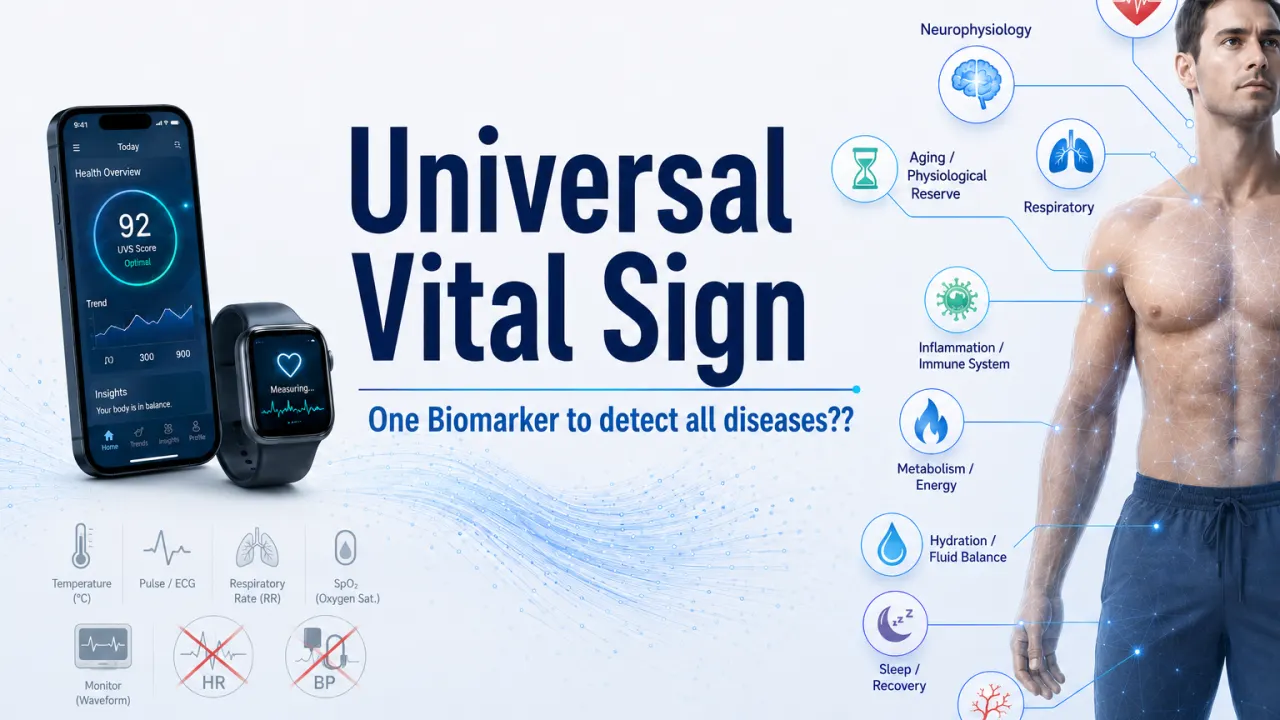
A true UVS should not be only cardiovascular. It should capture the body as a system. It should include cardiovascular strain, respiratory compensation, autonomic nervous system balance, microvascular function, inflammatory burden, metabolic stress, hydration and plasma volume shifts, sleep and recovery state, neurophysiological performance, and aging-related physiological reserve.
The goal is not to oversimplify the human body into one magical score. The goal is to build a high-dimensional model of the body and express its state in a way humans can understand.
That distinction matters.
UVS should not claim: “This detects all diseases.”
That would be scientifically weak.
The stronger claim is this:
Many diseases create shared patterns of physiological disruption before they become clinically obvious. UVS aims to detect that disruption early, continuously, and personally.
UVS is not a disease detector. It is a body-state detector. A stability signal. A warning light. A trajectory marker. A way to understand whether the human body is holding, adapting, compensating, recovering, or failing.
The Measurement Vacuum
This matters even more now because the therapeutic world is changing fast.
If the next decade of medicine is about AI-designed drugs, disease-modifying treatments, anti-inflammatory therapeutics, metabolic reprogramming, longevity interventions, and personalized prevention, then we need a better way to measure whether the body is actually improving.
How do we know when to start an intervention? How do we know whether it is working? How do we know whether the body is moving toward recovery or silent deterioration? How do we detect disease before the current clinical threshold is crossed? How do we monitor the effect of powerful new treatments in real time?
Right now, there is a measurement vacuum.
We are building more powerful therapies, but still using old physiological dashboards.
That gap needs to close.
Why AI Changes the Timing
This is why AI changes the timing. UVS was not realistic twenty years ago. It may be realistic now.
Not because AI is magic, but because AI can detect patterns across weak signals that human beings cannot interpret manually.
Phone cameras can capture vascular and microvascular signals. Wearables can capture heart rate, HRV, sleep, temperature, movement, and recovery patterns. Voice may carry respiratory, neurological, and emotional-state information. Behavioral patterns may reflect fatigue, cognition, illness, or recovery. Continuous data can reveal what a single clinic reading will always miss.
The future vital sign may not come from one sensor.
It may come from many weak signals fused into one personalized physiological map.
That is why this is the right time to talk about UVS. Not ten years from now. Now.
What Needs to Be Built
Building UVS will require serious infrastructure. We need better sensors, better phone-based physiology, better wearable integration, better longitudinal datasets, better personal baselines, and better validation across age, sex, ethnicity, climate, medications, sleep, stress, travel, disease states, and lifestyle.
Most importantly, we need models that understand physiology, not just correlations.
We need endpoints that prove UVS can predict meaningful outcomes. We need to know when a UVS change is noise, when it is adaptation, and when it is early disease. We need to know when the body is simply responding to life, and when it is quietly moving toward illness.
This is not easy.
But easy ideas rarely change medicine.
Why We Are Working on This at Hii.Health
At Hii.Health, this is one of the reasons we are deeply interested in digital biomarkers. We are working on new ways to measure human physiology through devices people already use: phones and wearables. We are exploring digital biomarkers for hydration, inflammation, aging, vascular function, and broader physiological state changes.
Each of these may look like a separate biomarker today, but I believe they are also building blocks for something larger.
A future where we do not only measure isolated numbers.
A future where we measure the body as a living, adaptive, multi-system network.
The next generation of medicine will not only be about discovering new treatments. It will also be about discovering new ways to measure the human body.
Because if we cannot measure physiological change early, continuously, and personally, we will always be late.
The Next Big Question
Maybe UVS sounds crazy today.
But many important ideas in medicine started as uncomfortable questions.
Can we see inside the body without cutting it open? Can we restart a stopped heart? Can we replace insulin? Can we predict protein structure? Can we design drugs with AI?
So maybe the next question is:
Can we build one universal physiological signal that tells us when the human body is drifting away from health?
I think we should try.
UVS.
The physiological mother of all vital signs.
You finished · 7 min read
Originally published on LinkedIn by Dr Yudara Kularathne MD, FAMS(EM).