Dengue is usually introduced to the public as a mosquito-borne viral fever. That is true, but it is incomplete.
Clinically, the most dangerous part of dengue is not the fever itself. It is what happens when the fever starts to settle, when the patient may look like they are improving, but the vascular system is quietly moving into a dangerous state. This is the famous critical phase of dengue. It is the window where plasma leakage, endothelial dysfunction, peripheral vasoconstriction, narrowing pulse pressure, shock, bleeding, organ injury, and sometimes death can appear within hours.
That is why I believe dengue is one of the most important diseases in the world for a new generation of digital biomarkers.
Not just heart rate. Not just blood pressure. Not just oxygen saturation.
Microvascular vitals.
Dengue is a disease of the circulation before it becomes a disease of the blood pressure.
This matters because our current monitoring systems are still built around late signals. We check temperature. We check blood pressure. We check pulse rate. We send blood tests for platelet count and hematocrit. We look for warning signs. We use clinical judgment. All of this is important and will continue to be important.
But the body does not collapse all at once.
Before blood pressure drops, the body compensates. Before shock becomes obvious, the peripheral circulation changes. Before the central circulation fails, the body tries to protect it. Before a nurse or doctor sees a dramatic change in a vital sign, the microvascular system may already be showing a pattern.
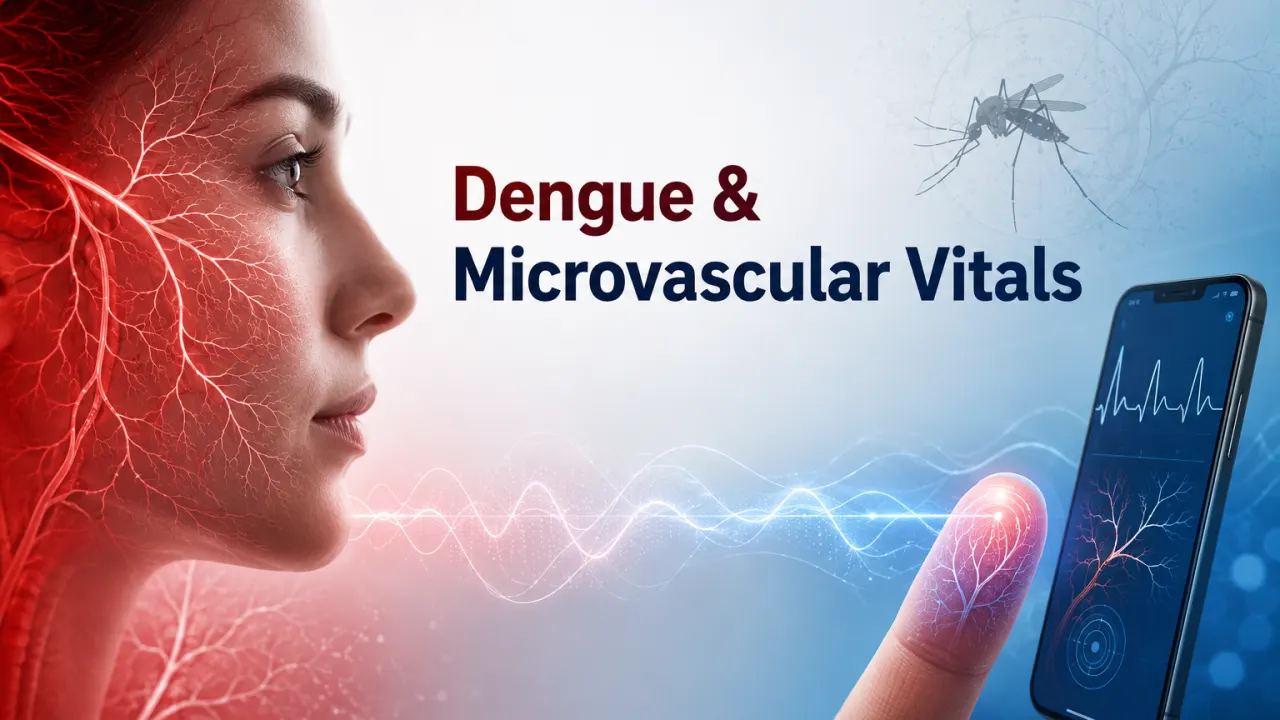
This is where photoplethysmography, or PPG, and remote photoplethysmography, or rPPG, become very interesting.
PPG is the optical technology used in pulse oximeters and many wearables. It measures tiny changes in blood volume using light. rPPG uses a camera to detect similar physiological changes without physical contact. In simple terms, a phone camera or wearable sensor can capture pulsatile signals from the skin that carry information about perfusion, vascular tone, autonomic response, waveform morphology, and cardiovascular compensation.
For years, most consumer devices used these signals mainly to measure heart rate. But the raw waveform contains much more information.
In dengue, that information may be extremely valuable.
The reason is simple: dengue complications are not only virological events. They are hemodynamic events. They are endothelial events. They are microvascular events.
The dengue virus triggers an inflammatory and endothelial response. In some patients, the vascular barrier becomes leaky. Plasma moves out of the intravascular space. The circulating volume drops. The body responds by increasing sympathetic tone, constricting peripheral vessels, preserving central circulation, and maintaining blood pressure for as long as possible.
This compensation is protective, but it hides the disease.
A child or adult with dengue may still have a “normal” blood pressure while the circulation is already under stress. The pulse pressure may narrow. The peripheries may cool. Capillary refill may become slower. The hematocrit may rise. But these changes are often intermittent, observer-dependent, or captured only when someone happens to check.
In a busy ward, during a dengue outbreak, that is a real problem.
In a resource-poor setting, it becomes a national problem.
Dengue creates a very difficult health system challenge. Most patients will recover with supportive care. A smaller proportion will deteriorate. But because the deterioration can happen quickly, health systems often have to monitor many patients closely to find the few who will progress. During outbreaks, hospitals become overloaded, beds fill up, blood tests are repeated frequently, nurses are stretched, and clinicians are forced to make high-stakes decisions with limited information.
The global burden is increasing. Dengue is now endemic in more than 100 countries. Hundreds of millions of infections are estimated each year. The largest burden remains in tropical and subtropical regions, especially in Asia and Latin America, but the disease is expanding with urbanization, climate change, human movement, and vector adaptation.
There is no specific antiviral treatment for dengue. The foundation of care is early recognition, careful monitoring, fluid management, and escalation when complications appear.
That is exactly why early physiological detection matters.
If we can detect the vascular transition earlier, we can change dengue care from reactive monitoring to predictive monitoring.
The future of dengue management should not depend only on waiting for blood pressure to fall.
One of the most exciting developments in this field is the emergence of wearable PPG data in dengue. Recent clinical work has shown that continuous PPG waveform analysis can help predict deterioration, recurrent shock, and even volume-state changes in severe dengue. These studies are important because they show that optical pulse waveforms are not just consumer wellness signals. They can carry clinically meaningful information about dengue physiology.
But I believe the next step is even more powerful: rPPG using existing cameras, especially mobile phones.
This is where our work is focused.
We are developing and validating rPPG-based digital biomarkers for dengue monitoring. Our approach is not simply to measure heart rate from a video. The real value is in the waveform. We are analyzing how the rPPG signal changes across time, how the pulse morphology shifts, how beat amplitude changes, how perfusion variability changes, how autonomic signatures change, and how these signals behave before conventional vital signs become abnormal.
One of the most unique concepts we are introducing is the comparison of two physiological systems: central circulation and peripheral circulation.
Instead of looking only at one signal from one site, we compare rPPG signals from the face with signals from the fingers.
The face gives us a window into more centrally preserved circulation. The finger gives us a window into peripheral circulation, where early compensatory changes often appear first. In dengue and other shock states, the body tries to protect the brain, heart, and central organs by sacrificing the periphery. Peripheral vessels constrict. Pulse amplitude falls. Waveform shape changes. Autonomic variability may flatten. Meanwhile, facial signals may remain relatively preserved, at least during the compensated phase.
That difference is the signal.
The delta between face and finger may be more informative than either site alone.
In other words, dengue may not only be detected through absolute values, but through physiological separation.
A patient may have acceptable blood pressure and a reasonable facial pulse signal, while the finger signal is already dampened. That mismatch may reflect early central–peripheral dissociation. It may indicate that the body is compensating. It may be the stage before decompensation. If validated at scale, this can become a new class of digital biomarker: the central–peripheral microvascular delta.
This is very different from traditional vital signs.
Blood pressure is a central macrocirculatory measurement. It tells us what is happening after many compensatory systems have already responded. PPG and rPPG can potentially show us the compensation itself.
That is the key insight.
In our time-series work, we are mapping these physiological changes across the dengue illness trajectory. Instead of taking one static measurement and calling it normal or abnormal, we track how digital biomarkers move over time. We study the direction, speed, and pattern of change. We look at whether the peripheral signal deteriorates before the facial signal. We look at whether waveform indices shift before blood pressure changes. We look at whether autonomic features become abnormal before clinical shock is obvious. We also model how these biomarkers may predict future changes, rather than only describe the current state.
This matters because dengue is dynamic.
A single normal reading in dengue is not reassuring if the trajectory is moving in the wrong direction.
The ideal dengue biomarker is not only a number. It is a trend.
The clinical vision is simple.
At the population level, people with suspected dengue could use a phone-based rPPG test from home or in the community. The test would not replace NS1, PCR, serology, or clinical diagnosis. Instead, it would add a physiological triage layer. In many real-world settings, especially during outbreaks, not everyone has immediate access to laboratory testing. A scalable digital biomarker could help identify who appears physiologically stable and can continue monitored home screening, and who needs medical review, blood testing, or hospital observation.
This could be especially important in countries where dengue outbreaks overwhelm primary care and emergency departments.
Imagine a national dengue program where suspected patients are not simply told to “come back if worse,” but are given a structured digital monitoring pathway. They perform regular phone-based measurements during the highest-risk days. The system tracks microvascular trends. It looks for central–peripheral divergence. It flags concerning deterioration. It recommends escalation when the risk score crosses validated thresholds. Public health teams can see population-level patterns. Hospitals can prioritize higher-risk patients earlier.
The goal is not to create panic. The goal is to create signal.
At the hospital level, the same technology can be used with different thresholds. A patient in the general ward with confirmed dengue can be monitored alongside standard care: blood pressure, pulse, urine output, hematocrit, platelets, fluid balance, ultrasound where available, and clinical warning signs. The rPPG score becomes an additional risk layer. It does not replace the doctor or nurse. It augments them.
This is important. Digital biomarkers should not compete with WHO guidelines. They should strengthen them.
WHO-aligned dengue care is based on early recognition, classification, monitoring for warning signs, careful fluid management, and timely escalation. A microvascular vital sign fits naturally into this pathway. It can help identify deterioration earlier. It can support monitoring during the critical phase. It can reduce dependence on intermittent observations. It can help clinicians decide who needs closer review.
The most powerful technology in medicine is often not the most complicated one. It is the one that fits into the biology and the workflow.
Dengue is almost perfect for this because the clinical question is so clear: who is going to deteriorate?
Most febrile illnesses need diagnosis. Dengue needs diagnosis, but it also needs risk stratification.
That is where digital biomarkers can have outsized impact.
For resource-poor countries, the importance is even greater. Many dengue-endemic regions do not have enough monitors, nurses, laboratory capacity, hospital beds, or ICU capacity during outbreaks. A solution that requires expensive hardware will not scale. A solution that requires continuous internet will not scale. A solution that requires central lines, advanced hemodynamic monitors, or specialist interpretation will not scale.
But a mobile phone already exists in the community.
That changes the equation.
If a phone camera can capture clinically useful physiological signals, then dengue monitoring can move beyond hospital walls. It can become distributed, repeated, low-cost, and population-scale.
This is the direction healthcare has to move.
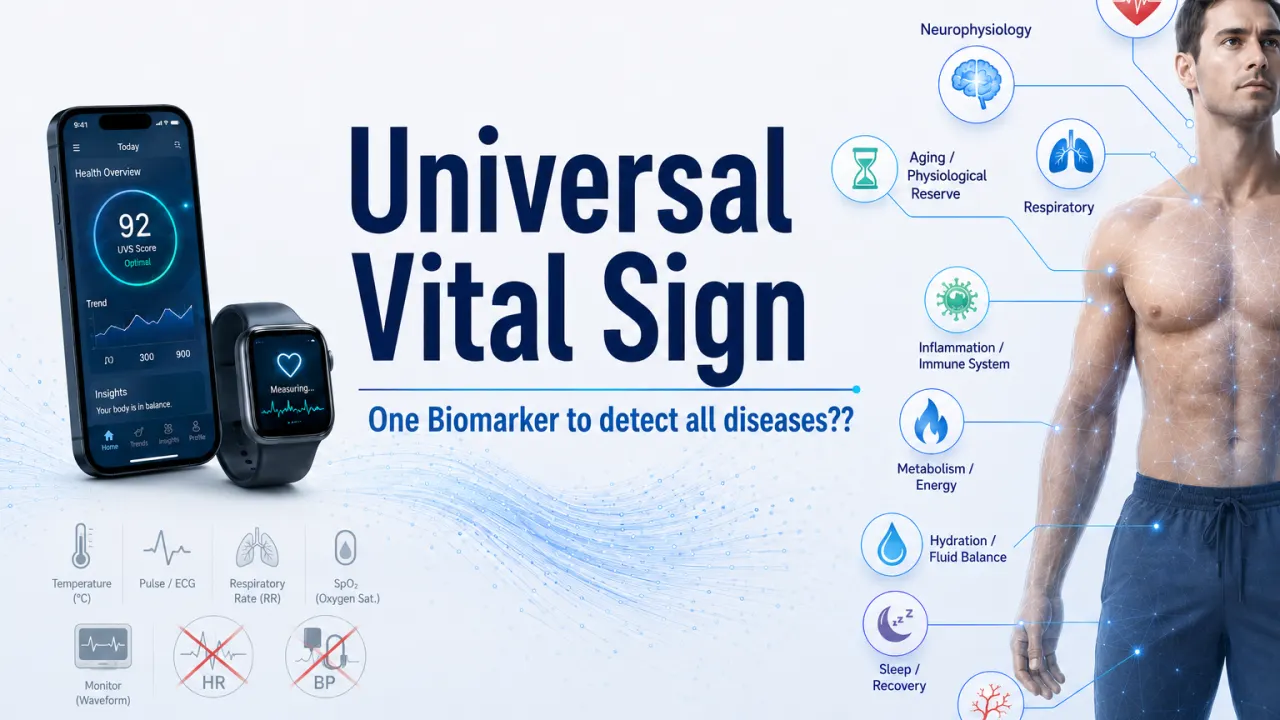
For too long, we have treated vital signs as a fixed set: heart rate, blood pressure, respiratory rate, oxygen saturation, temperature. These are important, but they are old. They were designed for bedside episodic assessment, not for continuous predictive physiology. The body is much richer than five numbers.
Microvascular vitals may become the next layer.
In dengue, these could include peripheral pulse amplitude, facial–finger perfusion gradient, waveform stiffness, reflection features, beat-to-beat perfusion variability, autonomic variability, recovery slopes, and trajectory-based risk scores. Some of these may be derived from contact PPG wearables. Others may be captured through rPPG using smartphone cameras. The best system may eventually combine both.
In the future, a dengue patient may not be monitored only by platelet count and blood pressure. They may have a daily or hourly microvascular trend. Their risk may be updated continuously. Their care pathway may adapt dynamically. Community patients may be reassured or escalated earlier. Ward patients may be reviewed before they crash. Fluid management may become more personalized.
This is not science fiction. The early evidence from wearable PPG is already emerging. Our rPPG work builds on the same physiological foundation, but aims to make it even more scalable by using cameras and central–peripheral signal comparison.
Of course, we must be careful.
Any digital biomarker used for dengue must be clinically validated. It must work across ages, skin tones, lighting conditions, phone models, disease days, serotypes, and real-world settings. It must show not only accuracy but clinical utility. It must reduce missed deterioration without creating unmanageable false alarms. It must be evaluated against meaningful endpoints: shock, plasma leakage, need for fluid bolus, ICU transfer, organ injury, length of stay, and mortality.
It must also be implemented ethically. Patients should understand that this is a monitoring tool, not a standalone diagnosis. Clinicians should see interpretable risk signals, not black-box outputs. Health systems should use it to support care, not to deny care.
But if we get this right, the impact can be very large.
Early detection changes everything in dengue.
It changes when a patient comes to hospital. It changes who gets observed. It changes how nurses prioritize patients. It changes how doctors interpret “normal” blood pressure. It changes how public health systems manage outbreaks. It changes how resource-poor countries allocate scarce beds and staff. Most importantly, it may change the point at which severe dengue is recognized: from late collapse to early compensation.
That is the real promise of microvascular vitals.
Not to replace medicine.
To see physiology earlier.
Dengue is a global disease, but it is also a local hospital problem, a rural clinic problem, a parent-at-home problem, and a national outbreak problem. The solution must therefore work at all of those levels.
A phone-based rPPG biomarker can potentially screen at population level.
A wearable PPG system can potentially monitor at ward level.
A central–peripheral rPPG delta can potentially reveal compensated shock before blood pressure falls.
A time-series model can potentially predict where the patient is going, not just where they are now.
This is why we are building in this space.
Dengue is not just a viral fever. It is a real-time vascular stress test created by nature. The microcirculation changes early. The periphery speaks before the blood pressure collapses. The face and fingers may tell different parts of the story. If we can listen carefully enough, using tools people already have, we may be able to detect complications earlier and save lives.
The next generation of dengue care will not be only about diagnosing infection.
It will be about monitoring physiology.
And in that future, microvascular vitals may become one of the most important tools we have.
You finished · 10 min read
Originally published on LinkedIn by Dr Yudara Kularathne MD, FAMS(EM) and Dr Thisara Perera.