
For the last decade, we have been putting more and more health data on people’s wrists: heart rate, sleep stages, SpO₂, HRV, respiratory rate, stress scores and readiness scores. We have built increasingly sophisticated dashboards around the human body.
But we are reaching an important point. People are not necessarily asking for more data. They are asking what the data means for their lives.
They do not necessarily want another graph showing that their HRV went from 42 to 47. They want to know:
Am I hydrated enough to think and perform well today?
Is something changing in my body before I actually feel sick?
Is the way I am living making me biologically younger or older?
Are the interventions I am spending time and money on actually improving my physiology?
That is the problem we are building Hii.Health to solve.
From Physiological Signals to Physiological Understanding
Today’s wearables are extraordinary pieces of engineering. They have taken physiological monitoring out of hospitals and laboratories and brought it into everyday life.
But there is an important distinction between measuring a physiological signal and understanding a physiological state.
Heart rate is a signal. HRV is an extremely useful physiological indicator. SpO₂ is an important measurement. But for most people, these numbers still require interpretation before they answer the question they actually care about:
What is happening inside my body, and what should I do about it?
We believe the next generation of digital health will increasingly answer that question directly. Instead of giving people more indirect measurements to interpret, we want to create a new class of digital biomarkers that represent meaningful biological states.
Hydration. Inflammatory physiology. Biological aging. And eventually, many more.
Start with the Sensors People Already Own
There is another problem with digital health: every new health insight seems to require another device. Another ring, another watch, another patch or another subscription.
For a small group of people who are deeply interested in quantified health, that may be perfectly reasonable. They want continuous data, and wearables are an incredibly powerful way to provide it. We want to support that world too.
But billions of people will never become hardcore quantified-self users. So our starting principle at Hii.Health is different:
Use the sensors people already have whenever possible.
The most abundant sophisticated sensor platform in the world is already sitting in our pockets: the smartphone.
Modern phones contain high-resolution cameras, accelerometers, gyroscopes, microphones, powerful processors and increasingly capable on-device AI. For much of what we are building, people should not need an expensive flagship phone.
Our ambition is that even a relatively simple camera phone — the kind of device hundreds of millions of people already carry — can become an entry point into understanding human physiology.
No new hardware. No major barrier to entry.
Open the phone, take a short measurement and understand something meaningful about your body.
For people who want continuous monitoring, the same physiological intelligence can eventually extend into watches, rings and other wearables.
Phone-first. Sensor-agnostic. Wearable-compatible.
The Three Generations of Camera-Based Physiological Monitoring
One way to understand where Hii.Health is heading is to look at how camera-based physiological sensing has evolved.
Generation 1: Can a Camera See Your Pulse?
Approximately 2008–2014
The first major question was remarkably simple:
Can an ordinary camera detect cardiovascular information from the human face?
The answer turned out to be yes.
In 2010, Ming-Zher Poh, Daniel McDuff and Rosalind Picard demonstrated automated, contact-free pulse measurement from facial video using ordinary cameras and blind source separation. Researchers including Gerard de Haan and colleagues at Philips subsequently developed increasingly robust chrominance-based approaches such as CHROM. Work at MIT on Eulerian Video Magnification also demonstrated just how much subtle physiological information exists inside apparently ordinary video.
The camera could detect tiny changes in blood volume that the human eye could not see.
This was a remarkable breakthrough. But the output was still mainly something we already knew how to measure: pulse and heart rate.
It was useful scientifically and technically, but limited in its ability to transform someone’s everyday health decisions.
Generation 2: Can We Extract Richer Physiological Measurements?
Approximately 2015–2022 and continuing today
The next phase moved beyond basic pulse extraction. Researchers and companies began deriving increasingly sophisticated cardiovascular and respiratory information, including heart-rate variability, respiratory rate, blood-pressure-related information, oxygenation-related signals and vascular or hemodynamic characteristics.
Machine learning and deep learning increasingly replaced or augmented handcrafted signal-processing pipelines. Algorithms also became better at dealing with motion, lighting and other real-world challenges.
The technology began moving from laboratories into commercial and regulated products. For example, Shen.AI’s Medical SDK received CE marking as a Class IIa medical device in 2026 for camera-based measurement of heart rate, heart-rate variability, breathing rate and systolic and diastolic blood pressure through a one-minute facial scan.
That is an important evolution.
Generation 1 extracted a pulse.
Generation 2 transformed that pulse into richer physiological indicators.
But we believe there is another step.
Generation 3: What Biological State Is the Person Actually In?
This is the frontier that excites us most.
Instead of asking, “What is the heart rate?” or “What is the HRV?”, we can start asking:
What can these rich physiological and visual signals tell us about a person’s biological state?
That means moving from measurement toward deep physiological and metabolic phenotyping.
This transition is already beginning. A recent example comes from Google Research. In August 2026, Google described PhotoScan, a research system that uses ordinary smartphone photographs to estimate body-composition characteristics associated with metabolic health.
When these camera-derived body-composition features were combined with demographic information, Google’s researchers reported an AUROC of 0.760 for insulin-resistance classification, compared with 0.773 using clinical DXA-derived features.
Importantly, PhotoScan is not rPPG. It is a different form of camera-based phenotyping. But philosophically, it represents the same transition:
The camera is no longer simply measuring something visible.
AI is learning to infer biological information hidden inside an ordinary image or physiological waveform.
That is Generation 3. And this is where we are building Hii.Health.
Our First Target: Hydration
Hydration sounds simple: drink water when you are thirsty. But human hydration is much more complex than that. It influences cognition, physical performance, recovery, cardiovascular physiology and how we function throughout the day.
Yet remarkably, we still do not have a convenient way for an ordinary person to repeatedly measure their hydration state.
At Hii.Health, we have been working to change that. Our hydration models have now been developed using more than 10,000 physiological data points and video-derived measurements.
We have completed a clinical study involving more than 100 participants, and our emerging digital biomarker has shown encouraging relationships with established physiological measurements, including serum sodium and osmolality.
The aim is not to tell somebody that their pulse is 72. The aim is to tell them something closer to:
This is your hydration state right now.
And eventually:
This is how your hydration is changing, and this is what you can do about it.
We are now working toward commercial products built around this technology.
Hydration illustrates something much bigger. Once we can reliably translate complex cardiovascular information into an understandable physiological state, the underlying technology becomes a platform rather than a single measurement.
The Second Frontier: Inflammation and Infection
Another major area of our work is the physiological response to infection and inflammation.
When an infection develops, the body does not simply wait until a laboratory biomarker becomes abnormal. Physiology changes. The vascular system changes. Circulation changes. Autonomic responses change. The shape and behavior of peripheral and central cardiovascular signals can also change.
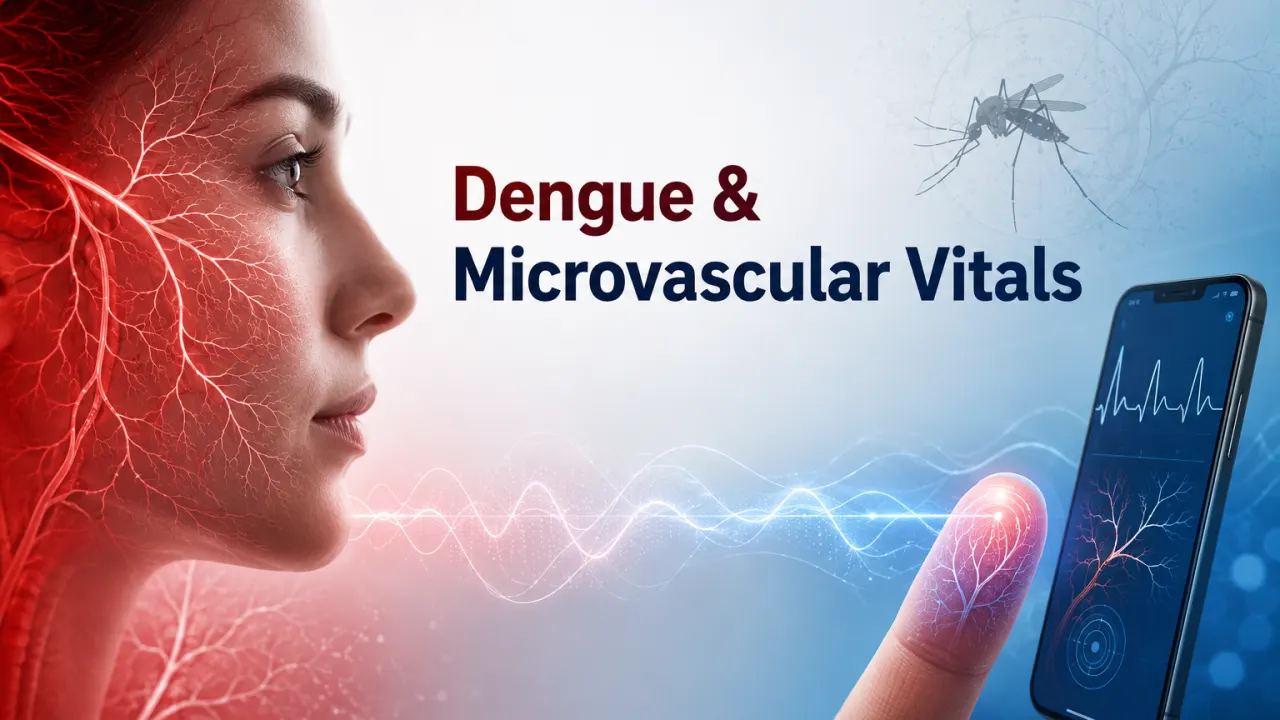
Our team has trained models using data from thousands of real patient measurements across different infections. These systems are now being studied in multiple hospital environments, including work around diseases such as dengue. We are investigating whether physiological signals can help identify infection and, importantly, detect patients developing complications earlier.
Multiple clinical studies in this area are ongoing.
The long-term question is fascinating:
Can a phone detect meaningful changes in systemic physiology before conventional monitoring makes those changes obvious?
Beyond acute infection lies an even larger opportunity. Chronic low-grade inflammation is deeply connected with long-term health and aging.
Imagine being able to understand not simply that your “inflammation number” changed, but eventually to learn which parts of your own life consistently move it: smoking, sleep, exercise, illness, recovery, nutrition and stress.
The biomarker becomes meaningful when it closes that feedback loop.
And Then There Is Aging
This may be the most ambitious problem we are working on.
Today, if someone is serious about measuring biological aging, some of the most established approaches require laboratory testing, including DNA methylation-based epigenetic-age measurements. These are powerful tools, but they are not something most people can measure every morning.
We are exploring a different question:
Could we create a digital biomarker of biological aging that can be measured non-invasively and repeatedly?
Not chronological age. Not simply resting heart rate. Not another generic wellness score.
We are exploring a physiological measurement designed to reflect how healthy — or unhealthy — the body is aging, benchmarked against established biological-age measurements.
Our work here is still early. But we already have more than 100 promising early data points and functioning research models, and we are continuing to investigate the relationship between these physiological signals, lifestyle and established biological-aging measurements.
Think about what this could eventually mean.
You exercise for three months. Does your biological physiology improve?
You improve your sleep. Does it move?
You stop smoking. Does it move?
You change your nutrition. Does it move?
You try a longevity intervention. Did it actually make a difference?
Instead of waiting months or years to understand the consequences of our behavior, imagine creating a much tighter feedback loop between how we live and how our body is aging.
Ultimately, perhaps one understandable number could help connect many different longevity interventions.
Not a measure of how sick you are.
A measure of how well you are aging.
The Future Is Not Another Dashboard
This is the fundamental thesis behind Hii.Health.
The first era of digital health was about collecting data. The second was about collecting more sophisticated data continuously. The next era will be about turning signals into biological meaning.
We do not think everyone needs another wearable. We do not think everyone wants 20 charts. And we certainly do not think people should need a biomedical-engineering degree to understand whether their health is improving.
For most people, the interface with their physiology may simply be the phone they already own. For people who want continuous, high-resolution monitoring, wearables can make that physiological layer even richer.
Both paths can converge on the same destination:
Digital biomarkers that tell us something meaningful about the state of the human body.
Hydration is one beginning. Inflammation and infection are another. Biological aging may become another. There will be more.
Some of this work is already in clinical validation. Some remains early-stage research. There is also a tremendous amount of science still to do.
But I believe the direction is clear:
We are moving from measuring signals to understanding physiology.
If we get this right, a device already carried by billions of people could become one of the most accessible windows we have ever had into human health.
That is what we are building at Hii.Health.
Not more health data. Health data that finally means something.
You finished · 8 min read
Originally published on LinkedIn by Dr Yudara Kularathne MD, FAMS(EM).