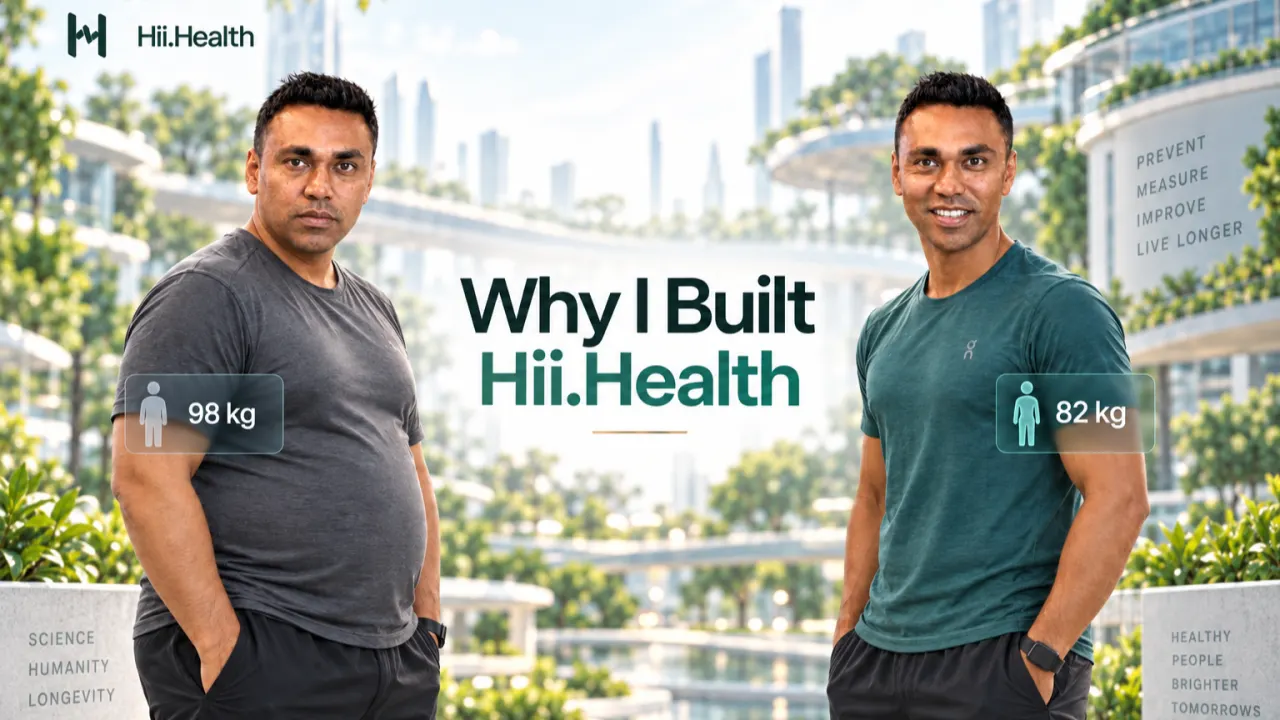
This is a very personal story. It is the story of how I went from 96 kg, hypertensive, pre-diabetic, hypercholesterolaemic, and with a biological age of almost 48 years to 82 kg, stronger, fitter, with my metabolic numbers back under control and a biological age of around 38 years.
And strangely enough, somewhere in that journey, I found the idea that eventually became Hii.Health.
At the end of 2024, HeHealth, my first real attempt at entrepreneurship, had failed. I call it learning now, but at the time I was probably in one of the worst situations of my 40+ years of life. I was financially broke, three years of very hard work hadn't gone the way I expected, and people were leaving my team. During the final phase of HeHealth, I was putting in completely unrealistic amounts of effort trying to save the company and keep the team afloat.
Unsurprisingly, my lifestyle became terrible. Binge eating, fast food, almost no exercise and very little sleep. Usually, I am a very active person. I was a national-level swimmer in my 20s, I'm 180 cm tall, and for almost my entire adult life I had managed to keep my weight below 90 kg. But during this period, everything started changing quite fast. I crossed 90 kg for the first time and eventually reached around 96 kg. Once that happened, things started going in the wrong direction surprisingly quickly.
On Christmas Day 2024, I happened to check my blood pressure and realised it was high. So, being a doctor, obviously I started checking everything else. Blood sugar. Cholesterol. The results were not pretty. Suddenly, I had gone from thinking of myself as a healthy, active person to looking at numbers suggesting hypertension, pre-diabetes and hypercholesterolaemia.
Then I checked my biological age. It was almost 48 years, with signs of accelerated ageing, when my chronological age was only 42. I think many people would have become even more stressed or depressed at that point. But not me. I got curious.
At the dawn of 2025, I made one of the most important decisions of my life. I bought a Fitbit (now Google health) 😂 That sounds ridiculously simple, but I made a promise to myself: get your shit together.
The question was how I was going to do that realistically. I was still extremely busy with startups, making my last attempts to save a dying company and trying to find ways to keep my team afloat. So suddenly becoming a full-time fitness influencer was obviously not an option. Instead, I made a conscious decision to make my life more balanced and become the best version of myself again. Because a startup doesn't benefit from a founder with a tired, stressed, non-functional brain. It benefits from a sharp one.
I started with the basics. I went back to running, starting with short 5 km runs at least twice a week. I started hitting the gym once or twice a week. I cleaned up my diet and significantly reduced carbohydrates. And most importantly, I started taking sleep seriously again, targeting around 7.5 hours every night. I started tracking everything through my Fitbit. Being a physician helped because I could actually make sense of many of those numbers. Slowly, things started moving in the right direction.
Then I hit my first problem.
My exercise tolerance was terrible. My VO₂ max was low. But the biggest problem was recovery. It was painful and slow. After running, my muscles would hurt for too long, and poor recovery started interfering with my ability to exercise consistently. So I put on my thinking hat. By this point, I had loads of health data and wearable data. Heart rate, sleep, HRV, exercise data, VO₂ max, weight, activity and all kinds of other metrics. But none of them answered the question I actually cared about:
Why am I recovering so badly, and how do I improve it?
I went through chart after chart and number after number, but there was no clear answer. I was drinking plenty of water. I was eating better. I was sleeping properly. But my recovery was still BAD. Then one day I happened to read an article about electrolytes and hydration, and immediately something clicked.
I live in Singapore. It is hot. I run outside. I sweat a lot. I was replacing the water I lost, but I had almost completely forgotten about the sodium and other electrolytes that were disappearing with it.
That led me to a surprisingly difficult question: how do I actually know whether I am properly hydrated?
That was when I realised something that genuinely shocked me. Even today, we don't have a simple, convenient and reasonably accurate way to measure hydration in real time. I was weighing myself before and after exercise and also checking my weight first thing every morning. Useful, but retrospective. I could look at my urine colour. Useful again. But most of the time, by the time my urine became obviously dark, I was reacting hours later. And by the next morning it might be back to normal, which was already too late if what I cared about was exercise recovery.
Even as a physician, surrounded by health data, wearable data and medical knowledge, I realised I was surprisingly blind to something as basic as hydration. So I started digging into the literature.
I came up with my own hydration plan. Basically, a home-cooked formula 😂
Instead of simply saying “drink more water,” I started estimating my fluid and sodium losses using body weight, exercise duration, sweat loss and some known hydration calculations. I built my first personal hydration protocol, including electrolytes.
Within about a week, I started noticing something. My recovery was much better. Less muscle pain. Less soreness. I could train more consistently, and slowly my running numbers started improving.
Previously, I actually avoided drinking much water before running because running with a stomach full of water is uncomfortable. With my new protocol, I started pre-loading smaller amounts of water with calculated sodium. That seemed to make a major difference.
Then I started experimenting further. I compared electrolyte drinks with ORS-type formulations and my homemade cocktail. Eventually, I found one electrolyte drink made by a Japanese pharmaceutical company that was surprisingly close to what I wanted. So I tried it. It worked well. Naturally, being me, I didn't buy a few bottles. I ordered around 60 litres in one shot 😂
And this experiment taught me something important. Fixing hydration properly with a personalised protocol was completely different from simply “drinking more water” or randomly drinking electrolytes. But one part of the problem remained unsolved.
I still couldn't measure it.
So now I put on my engineering hat. I started experimenting with my own wearable data and phone-captured facial videos. I wanted to know whether there was some signal hidden inside this data that could represent hydration. Surprisingly, there wasn't an obvious one. So we started training models.
The goal sounded simple: put a number on hydration. Because if my hydration protocol was going to become properly personalised, my health agent and I needed an objective measurement that we could monitor and optimise.
Simple idea.
Extremely difficult problem.
Oh boy, hydration taught us much more than my team and I expected.
We trained model after model, but nothing worked consistently. Signals changed with heart rate. Temperature interfered. Exercise changed things. Individual physiology changed things. Wearable signals were noisy. Face-video signals were noisy.
For roughly six months, we tested more than 100 models, analysed thousands of videos and spent countless hours looking through data, with very little success. Then one day, one of my team members suggested a completely different idea.
I can't explain exactly what it was here.
Funny enough, I had been thinking about something similar from a different direction. The whole team looked at it and thought, this might actually work.
So we went in. And finally, we found a signal.
We developed a model that produced results which, importantly for me as a physician, also made physiological and clinical sense. That was a big moment. It was strong enough that we decided to start formally studying the hydration biomarker. And somewhere along the way, something else had happened.
I had lost around 6–8 kg. My VO₂ max had improved significantly. My running was dramatically better, and my recovery had gone from terrible to, in my view, almost perfect.
Eventually, I reached around 82 kg.
And the biological-age estimate that had once told me I was almost 48 was now around 38.
That was when I started realising this problem was much bigger than me.
Hydration affects almost every human being on this planet. And in medicine, fluid balance is fundamental. Walk through almost any hospital in the world and you will see patients receiving intravenous fluids. Maintaining the right balance of water, electrolytes and circulation is one of the most basic requirements of human physiology.
Yet outside the hospital, most of us are still effectively guessing.
“Drink more water.”
“Look at your urine.”
“Drink when you're thirsty.”
That felt like a problem worth solving.
And it became one of the ideas that laid the foundation for Hii.Health.
A company built around a much bigger question:
What important things happening inside the human body are currently invisible, but could become measurable using the cameras and sensors already around us?
Hydration was my first problem.
But it wasn't the last.
By this point, I had two more problems I wanted to solve, and those two problems pushed the idea of Hii.Health much further.
I'll tell you about them in Part 2.
Thanks for reading.
Let's go, Hii.Health. 🚀
You finished · 7 min read
Originally published on LinkedIn by Dr Yudara Kularathne MD, FAMS(EM).